

Importance
The potato is an annual crop plant whose tubers contain important nutrients such as carbohydrate in the form of starch, protein, vitamins and Fe; it is consumed directly in the kitchen and also, after processing, in various forms (crisps, chips, etc.). In addition, when potato flour is mixed into bread flour at 3-5 %, it improves the flavour of the bread and delays staling. Varieties with a high starch content are used by industry (starch, alcohol, etc.), and a proportion is used as animal feed. Potato starch is very widely used in the manufacture of salami and sausages. As human food, the potato is consumed in very large quantities in the countries of Europe and America. As a staple food, the potato is as important in the countries of Europe as wheat is in Turkey. The potato is a hoed crop. It leaves clean, well-aerated soil for the crop that follows it. In the coastal regions under the influence of the Mediterranean climate, where winters are mild, the potato can be grown through the winter as an early crop, and very high tuber yields per decare can be obtained. Because land that would otherwise lie idle over the winter is put to use in these regions, this makes a major contribution to the national economy. World potato consumption has averaged 32.6 kg per person per year. That figure is 143.0 kg in Latvia and 132.1 kg in Poland, while in Turkey annual consumption per person has been 60.7 kg.
Botanical characteristics
The potato is an annual crop plant and is propagated by tubers or by seed. When a potato tuber is planted, the eyes on the tuber sprout and the plant forms roots, stolons and tubers below ground, while above ground it forms stems, leaves, flowers, fruit and seed. The botanical characteristics of the potato are therefore examined in two parts: the below-ground organs and the above-ground organs.
Below-ground organs
Root; The potato is a fibrous-rooted plant and, depending on the soil and the growing conditions, can reach a depth of 1 m. The root system of the potato generally develops within the top 30-40 cm of soil.
Stolon; As the root system of the potato plant develops within the soil, white extensions appear among the roots. These are called stolons. Tubers form as the tips of the stolons swell.
Tuber; The tuber that forms at the tip of the stolon carries eyes and the very small dots known as lenticels.
Lenticel; These act as windows between the interior of the tuber and the outside environment. They open and close according to ambient conditions. Water, CO2 and O2 pass in and out through the lenticels.
Eyes; These are the crescent-shaped features on the potato tuber which contain the buds that give rise to new plants. A potato tuber carries the fewest eyes at the heel end (the point where the tuber is attached to the stolon) and the most eyes at the crown (directly opposite the heel). The most developed eye at the crown is called the apical eye. The other eyes cannot sprout until the bud in this eye has sprouted. This is known as apical dominance (dominance of the terminal bud). This eye suppresses the other eyes. Once this eye is damaged in any way or has sprouted, the remaining eyes begin to sprout immediately afterwards. To obtain a large number of sprouts on a tuber, the apical sprout must be broken off. The eyes on the tuber may be shallow or deep. This is entirely a varietal characteristic. Shallow eyes are a desirable characteristic in tubers destined for table use and for industrial processing (crisps and chips). Potato tubers may be oval, round, round-oval, oval-long or flattened-cylindrical in shape. Tuber shape is entirely a varietal characteristic. A potato plant produces between 5 and 20 tubers. Tuber size generally ranges from 5 to 500 g. The skin colour of the potato tuber may be yellow, dirty yellow, brown or red. Differences in skin colour are not related to the tuber and flesh colour. When tubers first form they are pale yellow or pale pink. As the tuber matures and the skin sets, the colour darkens.
Chemical composition of potato tubers; The principal constituents of the potato tuber are starch, protein, minerals and vitamins. A high starch content is not wanted in table potatoes, because tubers with a high starch content disintegrate when boiled. In varieties with a high starch content the flesh is white. A high protein content in the tuber is characterised by yellow flesh. The potato tuber also contains solanine, an undesirable substance. Solanine forms close to the skin under the effect of sunlight. It is a toxic glycoside. Table potatoes should therefore not be left in the light.
Above-ground organs
A tuber generally produces between 2 and 6 stems. Tubers of 28-32 mm produce an average of 2.5 stems, tubers of 35-45 mm an average of 4 and tubers of 45-55 mm an average of 5. Stem length varies between 50 and 150 cm depending on environmental conditions and the cultural practices applied. The stem may be green or violet and is covered with hairs.
Leaf; The potato leaf is compound. A leaf is made up of 3-15 leaflets. The leaflets are arranged in opposite pairs along the leaf stalk.
Flower and fruit; The potato flower is five-parted. On the outside there are five sepals, then five petals, and within these five stamens together with the ovary and the stigma. Flower colour in the potato may be white, yellow or violet. The anthers of the stamens within the flower are yellow. The stigma is two-lobed and the ovary two-celled. The potato is predominantly self-pollinated. After the flower is fertilised, the ovary develops into the fruit. The fruit is green and the size of a walnut. It contains up to 300 seeds arranged side by side.
Climatic requirements
The potato is a plant of temperate and cool temperate climate regions. The haulm withstands -1.5 ºC to -1.7 ºC and the tuber -1.4 ºC to -2 ºC; at lower temperatures both plant and tuber are damaged. Low air temperatures damage the above-ground organs of the plant, but the plant can regenerate afterwards. When the air temperature rises above 30 ºC, plants begin to lose large amounts of water. To maintain their internal water balance they are therefore forced to close their stomata. Tuber growth stops. High air temperatures accelerate the vegetative growth of the plant but delay tuber formation. This in turn causes a fall in yield.
The potato is a short-day plant with respect to tuber formation and a long-day plant with respect to the formation of flowers, fruit and seed above ground. As day length increases, so does the period over which the plant can make use of light energy, and yield is therefore higher. Long-day conditions increase the vegetative growth of the plant but delay tuber formation. In Turkey potatoes are grown as a main crop in spring and summer. When they are grown in winter as an early crop, short-day conditions considerably shorten tuber formation and yield falls.
The energy required for photosynthesis is obtained from the sun. As light intensity increases, photosynthesis and therefore tuber yield increase. Since light intensity increases with altitude, tuber yield also rises at higher elevations.
Soil requirements
The potato can be grown on almost any soil apart from excessively stony and sandy soils. For optimum yield, however, the soil must be deep, free-draining, rich in organic matter and sandy in texture. The most suitable soil pH for potato growing is around 6.0-6.5. Potatoes cannot be grown on soils with a high water table or on barren (saline) soils.
Crop rotation
The potato leaves clean, well-aerated soil for the crop that follows it. Planting potatoes in the same field year after year is not recommended. Because the level of soil-borne disease increases, tuber yields fall significantly with each passing year. The potato fits into an excellent rotation with soya, cotton and cereals. In Adana the potato harvest takes place between the end of April and the beginning of May. If groundnuts are sown as a second crop after harvest, yield and quality improve.
Nutrient requirements and fertilisation
The potato responds very well to farmyard manure. 1.5-2.0 tonnes of farmyard manure per decare should be applied. The best course is for growers to have a soil analysis carried out and to use fertiliser according to the results. If no soil analysis has been carried out, 14-16 kg nitrogen, 8-10 kg phosphorus and 8-10 kg potassium per decare may be applied as pure nutrient.
Nitrogen fertilisation; The potato crop's requirement for nitrogen fertiliser is considerable. Because it is grown on sandy soils and requires a great deal of irrigation, a significant amount of nitrogen is leached. Excess nitrogen encourages vegetative growth and delays tuber formation. To prevent this, nitrogen fertiliser is recommended to be applied in at least two dressings. Half of the fertiliser should be applied at planting and half at ridging. On very sandy soils, nitrogen fertiliser should be mixed into the sprinkler irrigation water and applied in many separate doses. Nitrogen used at planting should be given as a compound with P and K (15.15.15) or on its own as ammonium sulphate. As a top dressing, nitrogen should be applied as ammonium nitrate or urea. On sandy soils that are irrigated frequently, ammonium sulphate is recommended as the top dressing.
Phosphorus fertilisation; For every 500 kg of tuber yield, 1 kg of pure P2O5 is removed by the plants; the proportion fixed in the soil, which depends on soil type, must also be included in the calculation. The whole of the calculated phosphate fertiliser should be applied before or at planting. Phosphate should be applied as a compound (20.20.0, - 15.15.15, or 18-46-0) or as triple superphosphate. Phosphate fertilisers encourage early growth and tuber formation and increase tuber numbers and resistance to disease.
Potassium fertilisation; All potassium fertiliser should be applied before or at planting. A 15.15.15 compound or potassium sulphate is generally used. Potassium increases dry matter accumulation in the tuber and its storage life, promotes skin set on the tuber, prevents the formation of undesirable enzymes in the tuber and gives the tuber flesh a firm texture.
Seedbed preparation
This varies with soil type and with the preceding crop grown before the potatoes. Good seedbed preparation is needed for rapid emergence and strong root development. Where no second crop is grown, the land is ploughed to a depth of 20-25 cm in July after the wheat harvest. Depending on the weed situation in the field, this cultivation is carried out as much as 1 month before planting. In autumn the soil is cultivated 1-2 times according to the weed situation.
Variety selection and seed
High-yielding varieties able to adapt to the region should be chosen. The seed must have been produced on upland sites (at least 1000 m above sea level) and must not be infected with disease.
It must have been stored under good conditions, and there must be no sprouts longer than 1 cm on the tuber.
It must not have been treated with sprout-suppressant chemicals. It must have reached physiological maturity. It must be of a size appropriate to the intended crop. There must be no varietal admixture.
Preparing seed tubers for planting
Most seed tubers are larger than required. As this increases costs, tubers larger than 70-80 g or 60 mm are cut. Tubers should be cut at least one day before planting and held in a humid, well-lit place so that a “suberin” tissue can form. Tubers should be cut from the inner part towards the heel, and the knives should be dipped frequently in alcohol. If the seed tubers are dormant before planting, dormancy should be broken by treating them with GA3 or similar chemicals. In addition, in early potatoes the tubers should be pre-sprouted in order to advance earliness. Pre-sprouting advances the crop by 15-20 days. Potato tubers stored in cold conditions should not be taken out of store and planted straight into the field. These tubers should be held for a period at around 15-20 C so that the eyes break quickly and the tuber passes out of the apical dominance phase.
Planting
Planting time; Potatoes should be planted after the last spring frosts, once the soil temperature reaches 8-10 ºC. Planting time varies from region to region. Summer potatoes are planted in April and May. Early potatoes are planted in the coastal regions between 15 December and 15 January. In Turkey the earliest planting is in the Mediterranean region (December-January), followed by İzmir-Aydın (January-February), Bursa-İnegöl (March), Bolu-Adapazarı (March-April), Niğde-Nevşehir (April-May) and Erzurum-Kars (May).
Planting density and seed rate; In seed potato production and early potato growing the planting is 70x25-30, while in normal potato growing a relatively wider spacing is recommended (70x30-35 cm). The size of the seed tuber to be used must be taken into account when setting the planting density.
Planting depth; Although it varies with soil type, planting time, tuber size, disease status, soil moisture and the physiological age of the tuber, planting depth is generally between 12 and 18 cm.
Planting methods; The main planting methods most widely used in potato growing are as follows;
a) Hill (station) planting
b) Furrow planting
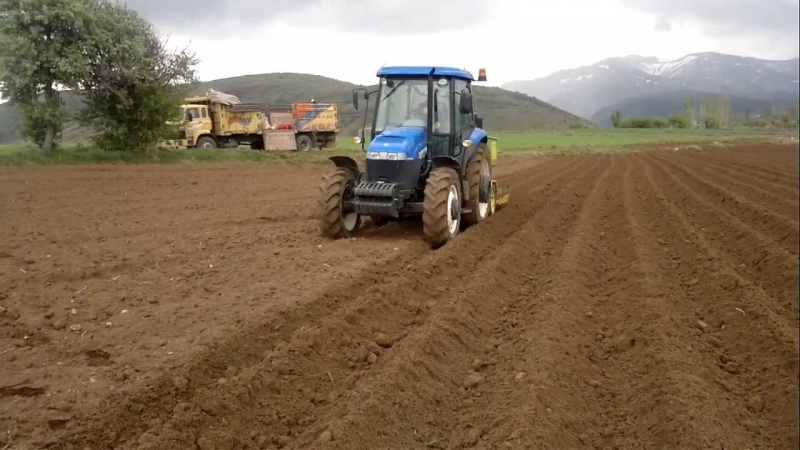
c) Machine planting
Crop care
The main crop care operations carried out in potatoes are: weed control, ridging, top dressing, irrigation, and pest and disease control. When the potatoes have 3-5 leaves the first shallow hoeing is carried out. This hoeing loosens the soil. Weeds are killed and moisture is conserved. Thereafter, at 20-day intervals (2-3 times if necessary), ridging is carried out together with each hoeing.
Harvest
In Adana the harvest of early potatoes begins in the last week of April and the first week of May and lasts 20-25 days. When potatoes are harvested the tubers must not be cut or bruised, no tubers should be left in the soil, and at lifting the soil must not be wet but at the correct moisture. Potatoes are lifted with a spade, fork or hoe and gathered by hand. They are also lifted with a plough, separated from the plant by hand and gathered.