

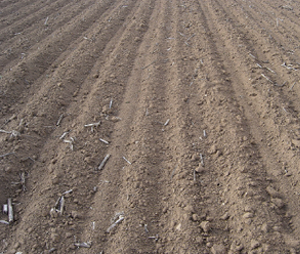
Where the soil is worked continuously to the same depth, a hard, impermeable layer 5-10 cm thick forms immediately below the working depth (20-25 cm); this layer is known as a hardpan. Being impermeable, it prevents water and rainfall from moving down through the profile and being stored there, while plant roots cannot break through it. Because soil compaction and hardpan formation together affect the physical, chemical and biological structure of the soil, they lead to significant reductions in plant growth and in yield. To break up this layer, subsoiling is recommended on land where the soil is dry. The subsoiler should be pulled at a depth of 50-60 cm while the soil is dry, for example in July and August.

This matters a great deal for crops such as potato, which form their tubers below ground. For good tuber development the potato needs a well-prepared, well-loosened seedbed, and the soil must be brought to a loose structure. In autumn, while the soil is at the right moisture for working, it should be ploughed with a mouldboard plough to a depth of 20-25 cm. In spring, once the soil has again reached the right moisture, a duckfoot cultivator and harrow combination should be worked through it to prepare a loose seedbed and bring the field into a condition ready for planting.